Channel loyalty software in India: what to look for
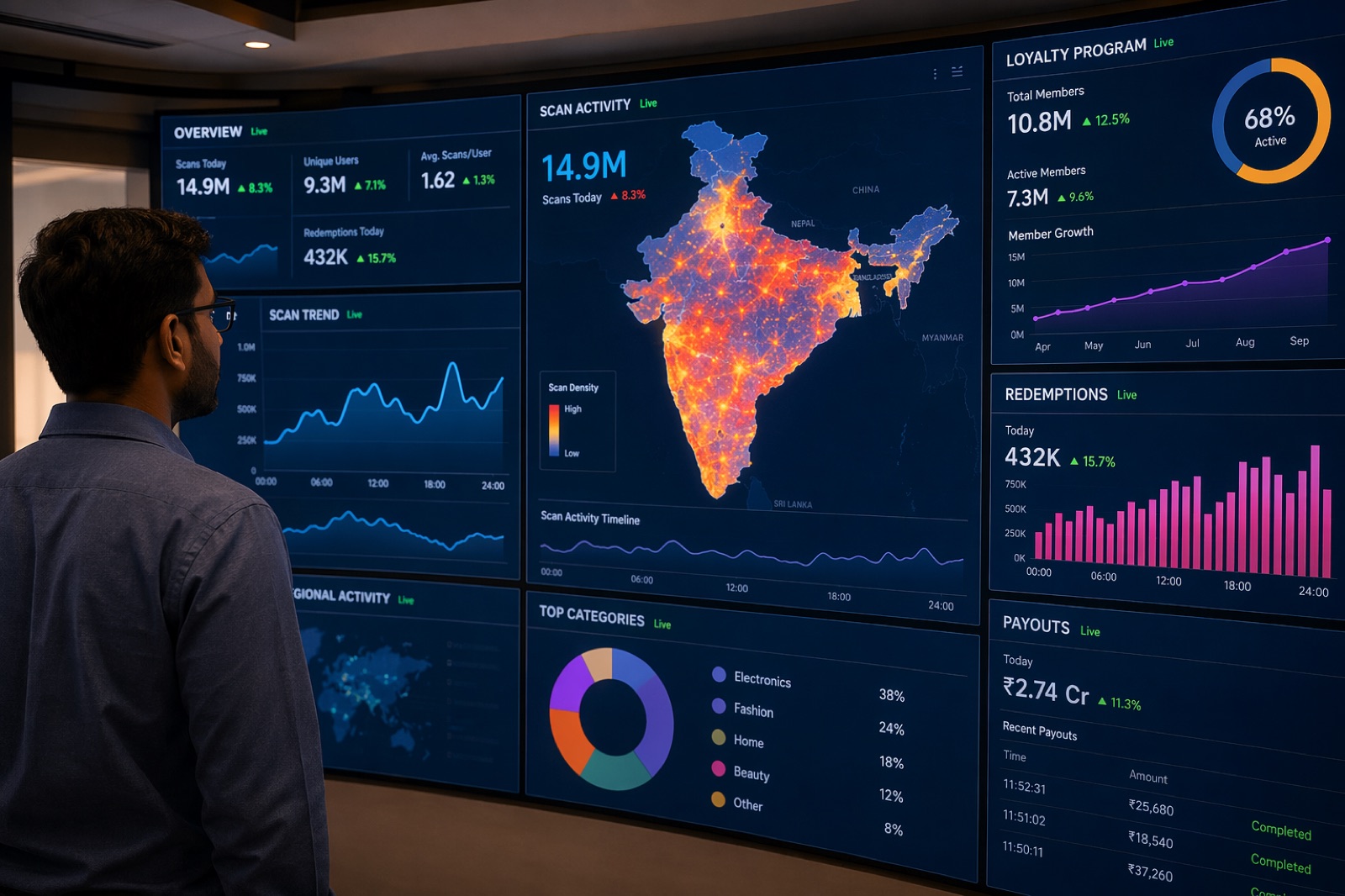
Every channel loyalty platform demo looks the same: a clean dashboard, a scan animation, a points balance, a map with dots on it. None of that is where programs fail. They fail on payout retries at 11pm on the last day of the quarter, on a state's worth of codes printed with the wrong check digit, on a 194R deduction nobody configured, and on a support queue in six languages. This is a guide to evaluating the parts that are not in the demo.
Key takeaways
- Judge a platform on payout reliability, code integrity and tax handling — not on dashboard design.
- Ask for failure numbers, not success numbers: failed-payout rate, retry success, duplicate-scan rate, support tickets per 100 active members.
- Section 194R handling must be native. Retrofitting tax onto a live member ledger is painful and visibly untrustworthy.
- The integration that matters most is not your ERP — it is your packing line.
The seven capabilities that actually decide outcomes
Serialisation and code integrity
Can it generate a sparse, non-sequential keyspace with check digits, at the volumes your packing line runs, and hand off files your printer can consume? Can it invalidate a batch after a recall? Can it survive the same code being scanned in two districts within a second — which will happen the first time someone photographs one.
Scan validation at real scale
A platform that validates 200 scans a second in a demo and 20 during a festive-window spike will produce a queue of members who believe they were cheated. Ask for peak-load figures from a live account, and what happens to a scan submitted while the member is offline in a basement.
Payout rails and their failure modes
UPI, bank transfer, and the failure paths: wrong VPA, name mismatch, bank downtime, limits, reversals. What is the first-attempt success rate across their base? What is the automatic retry policy? Where does a member see a failed payout, and how does he fix it without calling anyone?
Section 194R and tax handling
Native aggregation of benefit value per PAN across every scheme, automatic 10% deduction past ₹20,000 in a financial year, gift-in-kind valuation, visible deduction in the member ledger, certificate generation and a clean export for your finance team. Anything less becomes a manual reconciliation project that grows every quarter.
Fraud detection you can tune
Geo-velocity, dealer-pattern clustering, device fingerprinting, duplicate-image detection for photo-based claims, and — critically — the ability to set thresholds yourself and to escalate to review rather than block. A black-box fraud engine you cannot tune will either bleed money or block honest members, and you will not know which.
Multilingual member experience and support
Eight to twelve Indian languages across the member journey, not just the landing screen. And ask who answers the phone: an outsourced queue that speaks two languages will quietly cap your program's geography.
Reporting that answers business questions
Not scan counts. Cohort retention, revenue share from engaged members against control districts, redemption backlog, payout success trend, leakage estimates by district. If the reporting cannot support the ROI conversation you will have in month nine, you will build it in spreadsheets.
The integration nobody scopes properly
Brands spend the evaluation arguing about ERP and DMS connectors, and then discover that the hard integration is physical. Variable-data printing at line speed, label placement that survives coiling, shrink-wrapping and transit, reject handling when a code prints badly, and reconciliation between codes generated, codes printed and codes shipped. Get your production and packaging teams into the vendor evaluation, and make the vendor answer their questions rather than yours.
On the software side, the honest scope is smaller than vendors suggest: master data for SKUs and channel hierarchy, dispatch data for secondary-sales attribution, and a finance export for payouts and TDS. The DMS versus loyalty platform comparison covers where each system's responsibility should stop.
Questions to ask that vendors do not expect
- What percentage of payouts fail on first attempt across your live accounts, and what is the retry success rate?
- Show me a member ledger with a 194R deduction on it, from a real account with the identifiers removed.
- What happens to a scan made offline in a basement, and how many of those fail to sync in a month?
- How many support tickets per 100 monthly active members do your accounts average, and what is the top category?
- What was your worst incident in the last year and what changed afterwards?
- If we leave, what do we get — member records, ledger history, unredeemed liability, code databases — and in what format?
- Who owns the member relationship in your contract, and can you use our channel data for anything?
That last pair matters more than pricing. Member data and unredeemed point liability are the two assets a program accumulates, and both should be unambiguously yours. Our vendor selection and RFP guide has a fuller scoring framework.
What channel loyalty software costs in India
Commercial models fall into three shapes, and the one you choose changes vendor incentives:
| Model | Typical range | Vendor is incentivised to |
|---|---|---|
| Per monthly active user | ₹30,000 – ₹3,00,000 / month by MAU and modules | Grow engaged members — usually aligned with you |
| Percentage of reward value disbursed | 1–4% of payout value | Grow payout volume, which may not be aligned |
| Fixed licence plus implementation | Annual licence plus one-time build | Close the deal; less aligned with ongoing engagement |
Whatever the headline, model the total: platform fee, reward pool, serialisation and printing, payout transaction charges, field activation and support. The cost calculator covers the first four; the last two are usually where budgets slip. Our own pricing sits in the per-MAU band, on the pricing page.
Build versus buy, honestly
Building is defensible when channel loyalty is genuinely your core differentiation and you have a permanent engineering team for it. For everyone else, the two-year detour is spent on exactly the parts nobody demos: payout failure handling, code integrity at scale, tax compliance, fraud tuning and multilingual support operations. The screens are the easy part, and they are the part that build-versus-buy decisions are usually made on.
Frequently asked questions
What should I evaluate first in channel loyalty software?
Payout reliability, code integrity and Section 194R handling. Dashboards and scan animations are commodity; first-attempt payout success rates, non-sequential code generation with check digits at packing-line speed, and native per-PAN tax aggregation are what determine whether the program survives its second year.
How much does channel loyalty software cost in India?
Most platforms price per monthly active user, commonly ₹30,000 to ₹3 lakh a month depending on active members and modules. Others charge a percentage of reward value disbursed, typically 1–4%, or a fixed licence plus implementation. Model the full cost including reward pool, serialisation and printing, payout charges and field activation.
Does the software need to handle Section 194R?
Yes, natively. It must aggregate benefit value per PAN across every scheme a member touches, deduct 10% past ₹20,000 in a financial year, value gifts in kind, show the deduction in the member's own ledger and generate certificates. Retrofitting tax onto a live member base is both operationally painful and visibly untrustworthy to members.
What integration matters most for a loyalty platform?
The packing line, not the ERP. Variable-data printing at line speed, label placement that survives coiling and transit, reject handling and reconciliation between codes generated, printed and shipped are where launches slip by a quarter. Software integrations are usually limited to SKU and channel master data, dispatch data and a finance export.
Should we build our own channel loyalty platform?
Only if channel loyalty is a core differentiator and you can staff it permanently. The visible parts — screens, dashboards, scan flows — are the easy 20%. The rest is payout failure handling, code integrity at scale, tax compliance, tunable fraud detection and multilingual support operations, which take years to get right and never appear in a build estimate.
What data should we own in a vendor contract?
Member records, full ledger history, unredeemed point liability and the code databases, exportable in a usable format at any time. Also confirm in writing that the vendor cannot use your channel data for other purposes. These terms matter more than the monthly fee, because they determine whether you can ever leave.
How do I test a vendor's fraud detection?
Ask for tunable thresholds rather than a black box, and confirm suspicious activity can be escalated to review with the reward held pending rather than blocked outright. Then ask for their duplicate-scan rate, their estimated leakage as a percentage of pool, and an example of a false positive they got wrong and how it was resolved.