Types of channel loyalty programs
Seven models cover essentially everything running in Indian channels today. Most real programs are a hybrid of two or three, but knowing which primary model you are choosing determines your cost structure, your data, and what will go wrong.
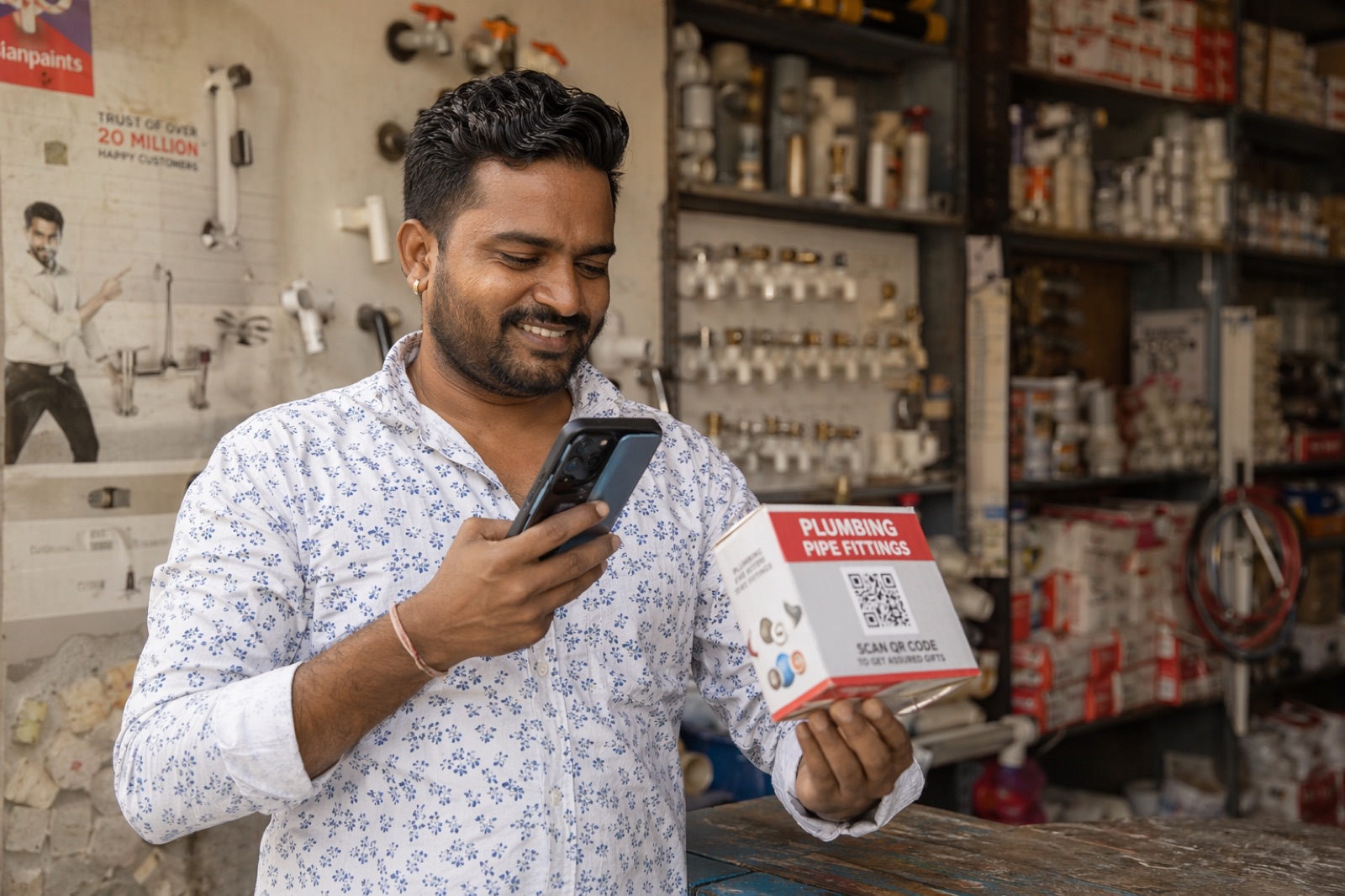
The seven main types are points-based, tiered, instant cashback, scan-to-earn, invoice-based slab, coalition, and hybrid programs. Indian channel programs most commonly combine scan-to-earn for trade influencers with invoice-based slabs for retailers and dealers, layering tiers and a points catalogue on top for retention.
The seven types
Points-based
Members accumulate points redeemable against a catalogue. Creates switching cost and enables tiers, but carries breakage risk and a real balance-sheet liability. Works when the catalogue is genuinely desirable and redemption is frictionless.
Tiered
Silver, Gold, Platinum with escalating benefits. Effective only when tiers change something material — allocation priority, credit, faster payouts, a named contact. Cosmetic tiers are seen through and resented.
Instant cashback
Money to UPI on each qualifying event. Wins enrolment and first-year engagement because it is unambiguous, but creates no switching cost — spent and forgotten.
Scan-to-earn
QR on the product, member scans, reward credited. The dominant model for Indian trade influencers. Requires serialisation and packing-line work, and returns unmatched data — see QR code programs.
Invoice-based slab
Percentage rebates against purchase value from ERP data. Standard for distributors and direct dealers. Cheap to run, entirely undifferentiated, and blind below the tier you invoice.
Coalition
Several non-competing brands share one program and one member base. Attractive in theory, difficult in practice — governance, cost sharing and data ownership are where these usually stall.
Hybrid
What almost every mature Indian program actually is: scan-to-earn for influencers, slabs for retailers, tiers and a points catalogue for retention, campaigns layered on top.
Choosing by channel structure
| Your channel | Primary type | Layer on top |
|---|---|---|
| Large field influencer base | Scan-to-earn | Points and milestones for retention |
| Distributors and direct dealers only | Invoice-based slab | Tiers with real benefits |
| Sub-dealers invisible in your ERP | Scan-in / scan-out | Range-width incentives |
| Durables with installation | Install registration | Warranty and consumer linkage |
| High counterfeit exposure | Scan-to-earn with verification | Anti-counterfeit reporting |
| Mixed, at scale | Hybrid | Campaigns on a single ledger |
Cost and complexity compared
| Type | Setup effort | Running cost | Data value |
|---|---|---|---|
| Points-based | Medium | Medium plus liability | High |
| Tiered | Low | Low | Medium |
| Instant cashback | Medium | High — no breakage | High |
| Scan-to-earn | High — packing line | Medium-high | Very high |
| Invoice-based slab | Low | Low | Low |
| Coalition | Very high | Shared | High but contested |
| Hybrid | High | Medium-high | Very high |
Note that the cheapest to set up — invoice slabs — is also the one that returns the least information. That trade-off is the central decision in channel program design, and it is why brands with a genuine visibility problem end up at scan-to-earn despite the packing-line work.
Failure modes by type
- Points: breakage treated as a saving, redemption friction added, and the channel eventually decides the points are fake. Target above 80% redemption.
- Tiered: tiers that change nothing material, so members read them as decoration.
- Cashback: becomes a price expectation with no relationship underneath.
- Scan-to-earn: code placement lets the wrong tier claim, or payout latency breaks the arithmetic of scanning for ₹5.
- Invoice slab: thresholds below baseline, so it is a discount with paperwork.
- Coalition: governance and data ownership disputes.
- Hybrid: multiple ledgers, so members cannot tell what they earned and 194R aggregation breaks.
A practical sequence
Most brands should not start with their eventual model. Start with the simplest structure that reaches the tier you most need to influence, prove payout reliability, then add layers. A common and effective path is: instant cashback on scans to drive enrolment in year one, points and tiers introduced in year two once trust exists, campaigns rotating on top from then on. The reasoning is in cash, coupons, points or gifts.
Frequently asked questions
What are the types of channel loyalty programs?
Seven models cover the field: points-based, tiered, instant cashback, scan-to-earn, invoice-based slab, coalition and hybrid. Indian channel programs most commonly combine scan-to-earn for trade influencers with invoice-based slabs for retailers and dealers, adding tiers and a points catalogue for retention.
Which loyalty program type is best for trade influencers?
Scan-to-earn, because tradesmen do not appear in your invoices and the only reliable way to reward them for what they install is a serialised code on the product. It requires packing-line work but returns the richest data of any model, including where your stock actually goes.
What is the cheapest type of channel loyalty program to run?
Invoice-based slabs, since they run off ERP data with no serialisation or enrolment work. They are also the model that returns the least information and is blind below the tier you directly invoice, which is the central trade-off in channel program design.
Are tiered loyalty programs effective in B2B?
Only when each tier changes something material — allocation priority during shortages, higher credit limits, faster payouts, a named contact, first access to launch stock. Tiers that differ only in name and rate are read as decoration and can actively generate resentment.
What is a coalition loyalty program?
Several non-competing brands sharing one program and one member base, so a member earns across all of them. Attractive in theory because acquisition cost is shared, but difficult in practice — governance, cost allocation and data ownership are where most coalition programs stall.
Should a brand start with points or cashback?
Usually cashback. Instant cash wins enrolment and first-year engagement because it is unambiguous and immediately useful, whereas points require members to extend credit to a brand they have no reason to trust yet. Introduce points, tiers and a catalogue in year two once payout reliability is proven.