Unotag vs Genefied
This is the most interesting comparison in the category, because it is not really about features. Genefied and Unotag both put a unique QR on a product and both do loyalty and verification — but we approach the same QR from opposite directions, and which direction is right depends entirely on which problem your board actually asked you to solve.
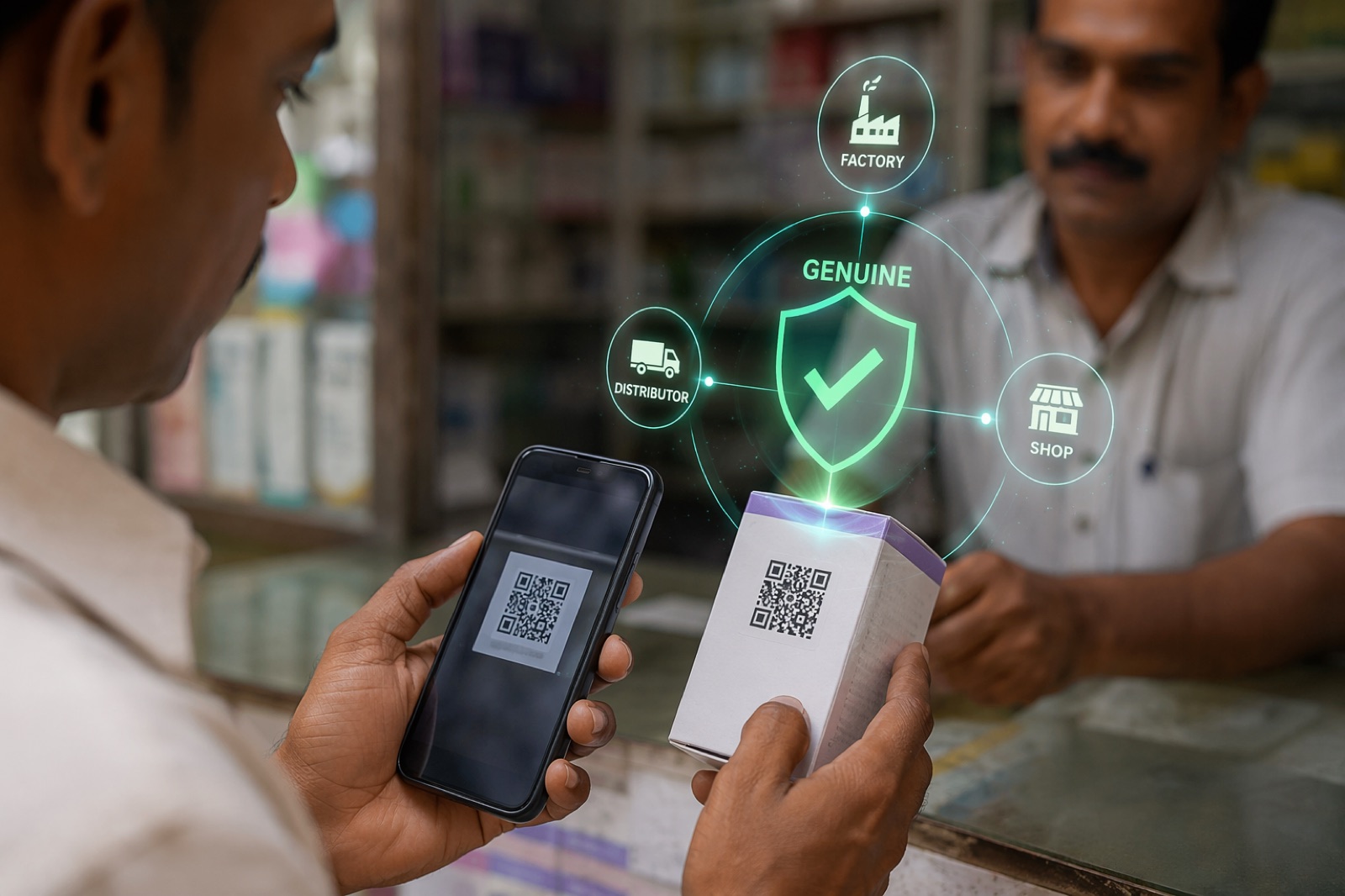
Two architectures, same hardware
| Genefied | Unotag | |
|---|---|---|
| Founded | 2018 | 2019, Bengaluru |
| Starting point | Anti-counterfeiting and product traceability | Channel loyalty and incentives |
| Loyalty position | Built on the verification identity | Verification built into the loyalty programme |
| Named products | Rewardify, Scan & Win, DWAM, SupplyBeam | QR programmes, invoice incentives, dealer incentives, dealer ordering, WhatsApp portal, AI and voice |
| Public partnerships | Century Plyboards, Lancer | Published case studies by industry |
| Published pricing | Not published | ₹30,000–₹3 lakh per month by MAU |
Genefied has also been recognised for anti-counterfeiting technology and describes digital warranty and supply-chain traceability alongside loyalty. That is a coherent product family and it is genuinely built around the thing it started with.
The question that decides it
Ask who inside your company owns the budget and what they were asked to fix:
- Brand protection or legal owns it, the trigger was seized counterfeit stock, and the success metric is fake product detected and removed → a verification-first architecture is the right shape, and Genefied is a serious answer.
- Sales or trade marketing owns it, the trigger was losing specification share to a competitor's scheme, and the success metric is share of business from engaged members → a loyalty-first architecture is the right shape, and that is what we build.
- Both, genuinely equally → whichever vendor lets one scan do both jobs without the second feeling bolted on. Test this in the pilot rather than in the demo.
Why we build loyalty-first, and what it costs us
Our argument is that in Indian trade channels verification only works if the tradesman is already scanning, and he only scans habitually if there is money in it. Serialise everything and publish a verification app, and scan rates stay low because nobody has a reason to bother. Pay ₹5 a fitting, and the same man scans forty times a day — and every one of those scans is also a verification event and a data point on where your material really goes. Verification rides on the loyalty habit.
The honest cost of our approach: we are not a brand-protection suite. If you need deep track-and-trace across a multi-tier supply chain, aggregation and serialisation hierarchies for regulatory purposes, or forensic tooling for enforcement actions, a verification-first vendor has spent more years on that than we have. We would tell you so in the meeting.
Where we are strong
- Field enrolment and retention — around 5 million members, WhatsApp-first onboarding, and the offline-scan-and-sync path that decides whether a basement scan is ever recorded.
- Payout reliability and Section 194R — aggregation per PAN across every scheme, deductions visible in the member's own ledger.
- Reward services — a 10,000-plus product catalogue with doorstep delivery and co-branded reloadable cards.
- The invalid-scan map. Because loyalty drives volume, our counterfeit signal is dense — clusters of failed code validations show where fakes are circulating months before the sales team reports it. That is the anti-counterfeit argument for a loyalty-first design, and it only works at scan volume.
What both of us should be asked
- Show a live invalid-scan map from a real account, identifiers removed. Density is the whole argument.
- What happens when a member scans a genuine code that has already been claimed — blocked, held for review, or silently failed?
- Where does the code physically sit, and can your printing partner apply it inside the primary pack at line speed?
- How is Section 194R aggregated when a member earns across three schemes?
- What do we get back on exit — member records, ledger history, code databases?
How to actually choose
Whichever way this lands, evaluate on the things that decide whether a program survives its second year rather than on the demo: first-attempt payout success rate, code integrity at packing-line volumes, native Section 194R aggregation per PAN, tunable fraud thresholds, support in your members' languages, and what you get back if you leave. Our vendor selection and RFP guide lists the questions vendors do not expect, and channel loyalty software in India covers the capabilities that matter underneath the dashboard.
About this comparison
This page is published by Unotag, so treat it as a vendor's point of view rather than an independent review. Everything stated about other companies comes from their own public material and from published press as of August 2026; products change, so verify current capability directly with each vendor. Where we do not know something — pricing in particular is rarely published by anyone in this category — we say so instead of guessing. If you find anything here inaccurate, tell us at support@unomok.com and we will correct it.
Frequently asked questions
What is the difference between Unotag and Genefied?
Genefied started in anti-counterfeiting and traceability in 2018 and builds loyalty on that verification identity, with products including Rewardify, Scan & Win, DWAM and SupplyBeam. Unotag started in channel loyalty in 2019 and builds verification into the loyalty programme. Same QR, opposite directions.
Should I choose an anti-counterfeit platform or a loyalty platform?
Ask who owns the budget and what they were asked to fix. If brand protection owns it and the trigger was seized counterfeit stock, a verification-first architecture fits. If sales or trade marketing owns it and the trigger was losing specification share, a loyalty-first architecture fits. If both matter equally, test in a pilot whether one scan really does both jobs.
Can one QR code do both verification and loyalty?
Yes, and it is the strongest design in trade categories, because the tradesman gets risk relief and reward from a single tap. The practical requirement is that neither function feels bolted on — the verification result and the reward should appear in the same screen, in the member's language, within seconds.
Why does Unotag build loyalty first rather than verification first?
Because in Indian trade channels verification only happens if the tradesman is already scanning, and he scans habitually only when there is money in it. A verification app with no reward produces low scan rates; paying per scan produces forty scans a day from one plumber, and every one is also a verification event.
Where is Genefied likely to be stronger than Unotag?
Deep track-and-trace across a multi-tier supply chain, serialisation and aggregation hierarchies for regulatory purposes, and forensic tooling for enforcement actions. They have spent more years on brand protection specifically, and we would say so rather than claim parity.
How does scan volume affect counterfeit detection?
Substantially. Every failed code validation is a data point, so the map of invalid scans is only useful if it is dense. A loyalty-driven programme generates far more scans than a verification-only one, which is why loyalty-first designs often surface counterfeit clusters months before field reports do.