Anti-counterfeit without QR codes or printing changes
Serialisation is the standard answer to counterfeiting, and it is a good one — but it requires a packing-line change, a printing budget, and product that has not shipped yet. None of that helps with the stock already sitting in your channel, and for many brands the line change is a nine-month conversation with manufacturing. There is a second route.
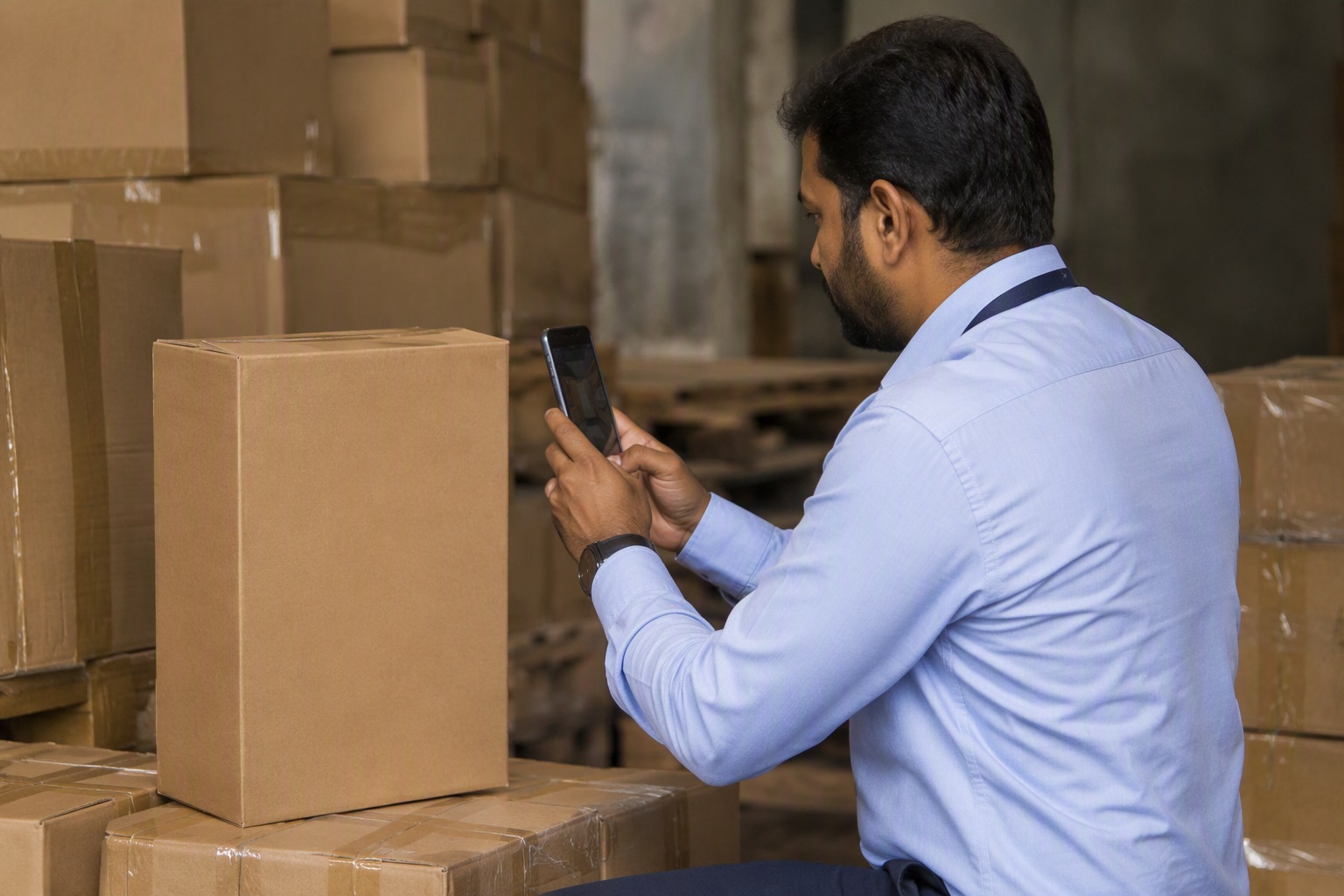
You can authenticate products without any code, label or packaging change by photographing genuine units to build a statistical model of what genuine looks like, then comparing field photographs of suspect stock against it. Because nothing is added to the product, it works retroactively on inventory already in the market — which serialisation, by definition, cannot do.
When serialisation is not available to you
- The stock is already in the channel. Codes can only be added to units not yet made. Everything in a distributor's godown today is unserialised forever.
- The packing line cannot take it. Variable-data printing at line speed is a real capital and engineering conversation, and for some lines the answer is no.
- You contract-manufacture and do not control the packaging process directly.
- The unit economics do not carry it. ₹0.15–0.80 per unit is trivial on a ₹3,000 pack and material on a ₹40 one.
- You need an answer this month, not after a packaging redesign cycle.
- The counterfeit is already circulating and you need to size the problem before justifying the investment.
That last case is the most common way brands arrive at image-based authentication. Somebody senior asks how bad the problem is, and there is no way to answer without checking product that carries no code.
How it works without anything on the pack
The product authenticates itself, because manufacturing leaves measurable fingerprints. What the system compares:
- Geometry. The relative positions of design elements, as ratios that survive camera distance. Redrawn artwork almost never reproduces every relationship exactly.
- Colour. Ink shifts across the pack, measured in a perceptually uniform space against the range seen across genuine units.
- Typography. Font substitutions and letterform differences that a vision model reads directly.
- Fine ornament. Guilloche, microtext and fine-line work degrade characteristically when redrawn or rescanned.
- Print structure. Halftone screening and screen angle, where the capture resolves them.
None of that requires the counterfeiter's cooperation, and none of it requires you to have anticipated the problem when the packaging was designed.
The honest comparison
| Serialisation | Image-based | |
|---|---|---|
| Works on existing stock | No | Yes |
| Packing-line change | Required | None |
| Per-unit cost | ₹0.15–0.80 | None |
| Setup | One line cycle plus integration | Photograph 20–50 genuine units per SKU |
| Consumer can self-verify | Yes, by scanning | Not practically — needs controlled capture |
| Doubles as a loyalty rail | Yes | No |
| Defeated by | Cloned codes | Uniform-scale exact copies |
| Evidence quality | Binary — code valid or not | Itemised visual differences |
Read that table as complementary rather than competitive. Serialisation gives you consumer-facing verification and, in trade categories, the scan volume that comes from paying tradesmen to scan. Image-based authentication gives you retroactive coverage and forensic evidence. Brands with a serious problem end up running both — codes on new production, image checks on everything else.
What you give up
Being straight about this matters, because the trade-offs are real:
- No consumer self-service. A homeowner cannot meaningfully authenticate a pack this way; capture quality requirements are too strict. This is a field-officer and channel-audit tool, not a consumer feature.
- Reference collection is work. Someone has to photograph genuine units properly, per SKU, across batches.
- Calibration is required. The first fifty real verifications tune the thresholds; treat them as setup.
- Some categories are hard. Curved surfaces, transparent packaging and flat-colour artwork all reduce reliability.
- No loyalty synergy. There is no scan to reward, so it generates no channel engagement and no secondary-sales data.
A sensible first deployment
- Pick the two SKUs you most suspect and the region you most suspect.
- Photograph 20–50 genuine units per SKU across several batches.
- Equip three or four field officers with the shot list and a clip-on macro lens.
- Run a market survey — buy suspect stock from the channel and verify it.
- Review every SUSPECT verdict by hand for the first month.
- Take the resulting district map to the meeting where the serialisation budget gets decided.
That last step is the practical value: image-based authentication is often the cheapest way to prove a counterfeit problem exists, which is the argument that unlocks the larger programme. The full method is in image-based product authentication, and the code-based route in QR code programs.
Frequently asked questions
Can you detect counterfeits without a QR code on the product?
Yes. Image-based authentication builds a statistical model of genuine appearance from photographs of known-good units, then compares field photographs of suspect stock against it. Nothing is added to the product, so it works on inventory already in the market — which serialisation cannot do.
Does image-based authentication work on stock already in the channel?
That is its main advantage. Serialised codes can only be applied to units not yet manufactured, so everything already sitting in distributor godowns is permanently unserialised. Image comparison needs nothing on the pack, so it applies retroactively to existing inventory.
What does it cost compared with serialisation?
There is no per-unit cost, against ₹0.15 to ₹0.80 per unit for printed codes, and no packing-line change. The setup cost is photographing 20 to 50 genuine units per SKU and calibrating thresholds, plus compute per verification. For a brand that cannot change its line, it is often the only available option.
Can customers verify products this way themselves?
Not practically. The capture quality requirements — sharpness, glare control, a fixed shot list — are too strict for casual consumer use, and a poor photograph produces an inconclusive result rather than a helpful one. This is a field-officer and channel-audit tool; consumer self-verification is what serialised codes are for.
Should we use image authentication or serialisation?
Both, if the problem is serious. Serialisation gives consumer-facing verification and, in trade categories, the scan volume that comes from rewarding tradesmen. Image-based authentication gives retroactive coverage of existing stock and itemised forensic evidence. They fail in different directions, which is precisely why running both closes the gap.
How quickly can image-based authentication be deployed?
Days rather than production cycles. The gating item is collecting genuine reference samples — 20 to 50 units per SKU across several batches — and then calibrating on the first fifty real field verifications. There is no packaging redesign, no line integration and no printing procurement.