How to create a cosmetics incentive program
A cosmetics brand reaches its customer through several hands: the distributor who supplies general trade, the counter owner who decides what goes on the display, the beauty advisor who recommends a shade, and the salon professional who uses a product on a client and tells her where to buy it. Each needs a different reward on a different proof. A program designed for only one of them leaves the others choosing another brand.
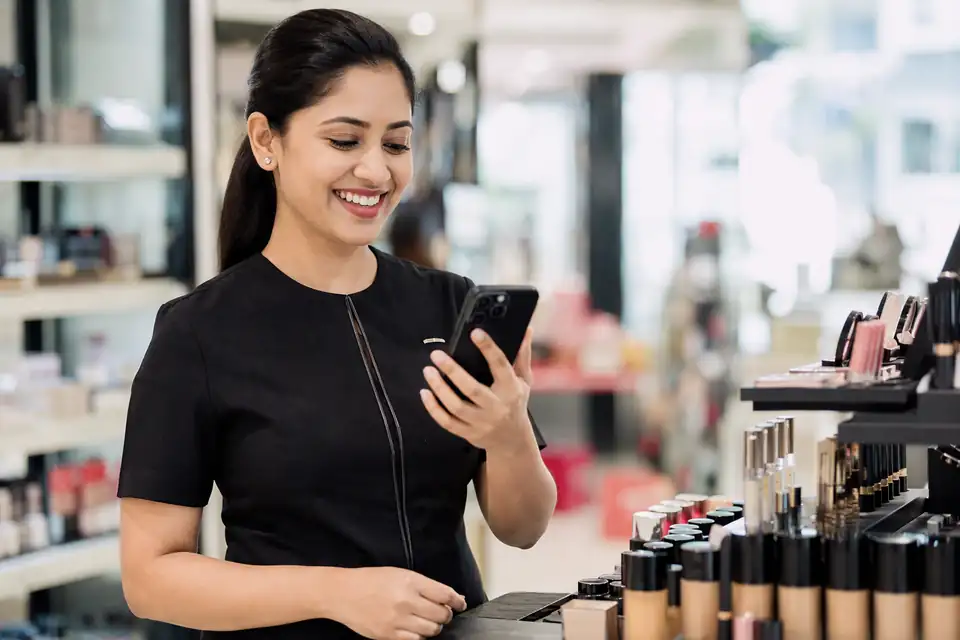
To create a cosmetics incentive program, set one objective per tier (distributor coverage, counter range and purchases, advisor sell-out, salon usage and retail resale), choose a proof for each (ERP and distributor invoices, bill photos, product scans, salon orders), keep tester and promotional stock out of scheme calculations, design short-cycle schemes with recognition as well as cash, and pilot in one city before rolling out.
One objective per tier
| Tier | What you want | Proof | Reward form |
|---|---|---|---|
| Distributor | Coverage of counters and steady buying across the range | Primary invoices from the ERP; secondary invoices | Slabs, growth, collection scheme, credit note |
| Cosmetic counter or GT retailer | Range on display and growing purchases | Distributor invoices or bill photo with OCR | Range-completion and purchase slabs, UPI or points |
| Beauty advisor | Sell-out of the brand at her counter | Product scan at sale or bill photo | Daily incentive, levels, badges, contests |
| Salon and professional | Use of professional range and retail resale to clients | Scans of professional packs; salon orders | Points, tiers, rewards catalogue, meets |
City tier matters as much as tier in the channel. A metro counter with an advisor, a small-town cosmetic shop and a general store with a beauty shelf buy and sell differently, so the same slab will be too easy for one and out of reach for another. Plan scheme thresholds by city tier from the start.
Seven steps to set it up
Write down the objective for each tier
Keep it to one or two per tier per quarter: for example, add the new serum range to more counters, and raise advisor sell-out of the premium line.
Build the partner master
Distributors, counters, advisors and salons with town, city tier, the distributor each buys from, and for advisors the counter they work at. The in-store promoter guide covers advisor records.
Choose the proof for each tier
Invoices for distributors and counters, a product QR scan or a bill photo for each advisor sale, and scans of professional packs for salons. A per-unit code, bound to the first scanner, keeps one sale from being claimed twice.
Exclude tester and promotional stock
Testers, gift-with-purchase stock and sample packs move through the same channel but should not count towards purchase slabs. Mark them as separate SKUs so they never enter the calculation.
Design schemes by tier
Range-completion and purchase slabs for counters, daily or weekly incentives with levels for advisors, per-scan points and tiers for salons, and slabs with growth and collection schemes for distributors. Short windows suit festive, wedding and new-launch periods.
Add recognition, not just cash
Advisors and salon professionals respond strongly to recognition: levels, badges, monthly top-performer lists and invitations to brand meets. Build these in from the start.
Pilot in one city
Choose one city with one distributor, a set of counters and a group of salons. Run two cycles, review advisor activity and counter range, then extend city by city.
- 1DistributorPrimary invoice counts for his slab
- 2CounterPurchase from distributor counts for range scheme
- 3Beauty advisorScans the unit at sale: daily incentive
- 4Code boundSecond scan of the same code blocked
- 5BrandSees which counters and advisors sell
Worked example: an advisor's daily incentive (illustrative)
An illustrative plan for an advisor at a cosmetic counter: ₹15 per unit of the core range scanned at sale, ₹40 per unit of the premium serum line, and a weekly bonus of ₹500 if she sells at least 25 premium units. On a day with 12 core and 4 premium units she sees ₹340 earned by evening, and on Thursday she sees she needs 6 more premium units for the weekly bonus. Run the plan on a few weeks of past sales before launch so the bonus threshold is reachable for a typical counter.
Languages, counterfeits and tax
Salon professionals and advisors in smaller cities often prefer support in their own language, by voice. Counterfeit and grey-market products are a real concern in beauty, and the same per-unit code that records a sale can confirm the product is genuine. Benefits given to businesses such as counters and salons may attract TDS under section 194R once they cross the annual threshold, and GST treatment depends on structure; confirm with your tax advisor.
What Unotag does for cosmetics brands
Unotag runs distributor, counter, advisor and salon programs on one platform: per-unit QR codes scanned on WhatsApp or the app with first-scan binding and duplicate blocking, bill photos with OCR, a scheme engine for distributor and counter schemes, commission statements with gamified levels for advisors, and UPI payouts or a rewards catalogue of more than 10,000 products. See the cosmetics page, the retailer incentive program and the influencer loyalty program.
Key takeaways
- Give each tier one objective and its own proof: invoices, bill photos, sale scans or professional-pack scans.
- Keep tester, sample and gift-with-purchase stock out of scheme calculations as separate SKUs.
- Pay advisors daily or weekly, with levels and badges alongside cash.
- Reward salons on professional use and retail resale, with tiers and meets.
- Pilot in one city and test every threshold on past sales before launch.
Frequently asked questions
What is a cosmetics incentive program?
A program that rewards a beauty brand's distributors, cosmetic counters, beauty advisors and salons for stocking, selling and using its products, based on invoices, bill photos and product scans.
How do you reward beauty advisors?
With a daily or weekly incentive on verified sales, levels and badges, contests and recognition at brand meets. Seeing the day's earning the same evening matters more than the size of the monthly bonus.
How should tester stock be handled in schemes?
Mark testers, samples and gift-with-purchase stock as separate SKUs so they do not count towards purchase slabs or advisor incentives.
What is a salon loyalty program?
A program that rewards salons and professionals for using a brand's professional range and reselling retail products, usually through scans of professional packs, orders, points, tiers and meets.
Can one QR code record a sale and check authenticity?
Yes. A per-unit code scanned at sale records the advisor's sale and confirms the product is genuine, and a second scan of the same code is blocked.
Do counter and salon rewards attract TDS?
They can, under section 194R, once benefits to one business cross the annual threshold. Confirm with your tax advisor.