Ag retail rewards: loyalty for agri-input retailers and farmers
The agri-input retailer is the most trusted adviser most farmers have. He extends credit until harvest, recommends the seed and the spray, and stocks six brands of each. An ag retail rewards program is how a brand earns a place on his recommendation without cutting price in a season where price is already under pressure.
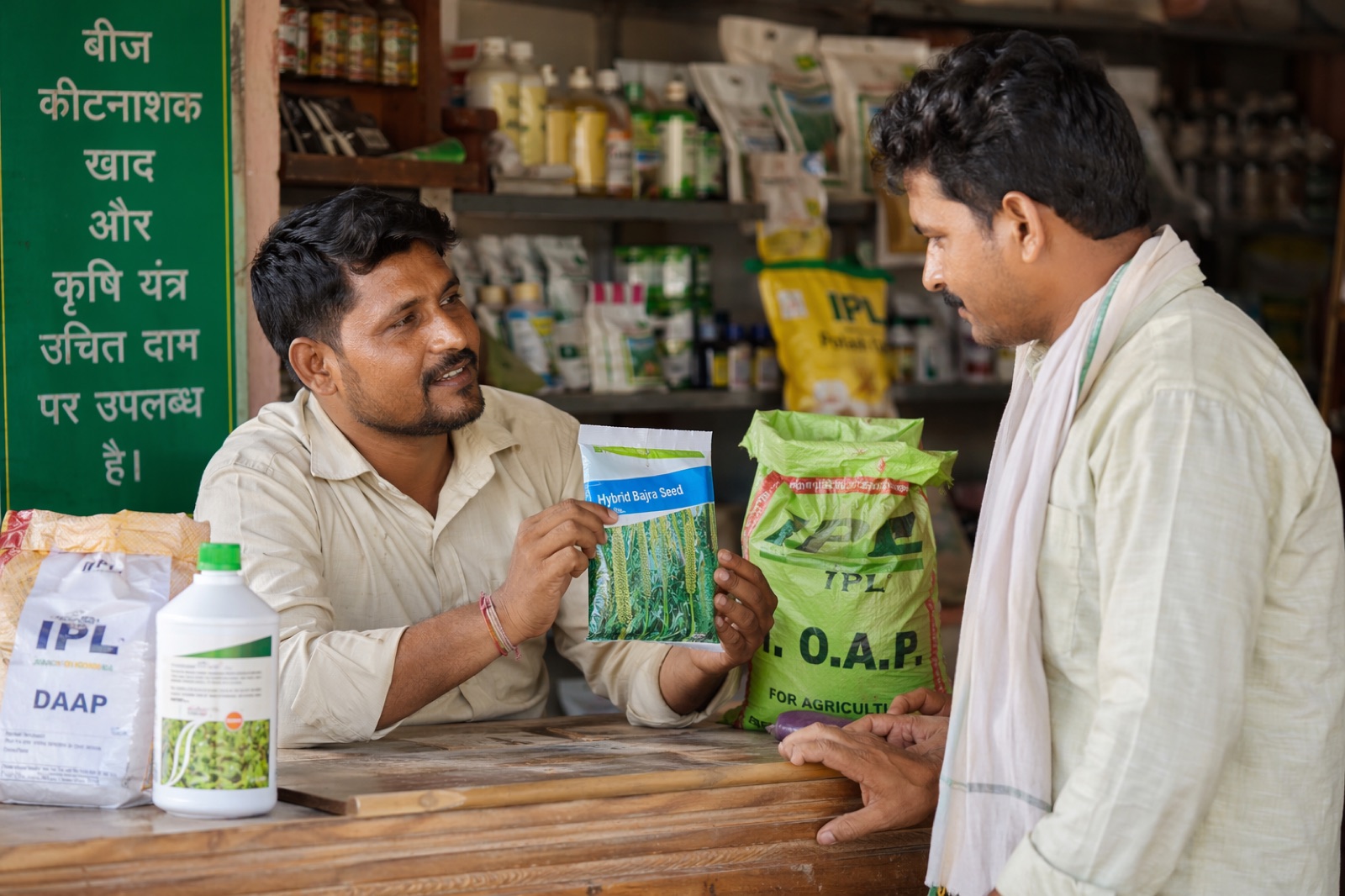
Ag retail rewards are loyalty and incentive programs run by seed, fertiliser, crop-protection and agri-equipment brands for the agri-input retailers, krishi kendras and, increasingly, the farmers who buy from them. The programs are built around kharif and rabi seasonality, earn on the retailer's scan of a serialised QR on the bag or bottle at stock-in, verify farmers by phone number and geography when they scan at purchase, and account for a channel where most sales are on credit until harvest. Rewards that work are inputs for the next season, equipment, insurance top-ups and cash by UPI, paid promptly at season end. Marketing of pesticides and fertilisers is regulated in India, so scheme communication must stay within product-claim rules; confirm the treatment with your advisor.
Why agri is its own playbook
- Two seasons, not twelve months. Kharif sowing in June and July and rabi sowing in October and November concentrate 70 to 80 percent of purchases into four months. A monthly scheme makes no sense; a season scheme does.
- Credit until harvest. The retailer sells on credit and collects after the crop is sold. A reward that arrives at season end, when his own receivables are still out, is worth more than its face value.
- The retailer recommends. Unlike a hardware counter, the krishi kendra owner is asked what to use. His recommendation is the influencer effect and the counter effect in one person.
- Regulated products. Fertiliser and pesticide sales are licensed and labelled under central and state rules. Scheme communication cannot make claims the label does not.
The agri-input loyalty post sets out the category; the chemicals and fertilisers and agri inputs pages cover the brand context. This post is the retailer and farmer mechanics.
Earning: the scan on the bag or bottle
A serialised QR on the fertiliser bag, seed packet or pesticide bottle is scanned twice. The retailer scans at stock-in, which proves the unit reached the counter and is the evidence for the retailer's season slab and the distributor's secondary sale. The farmer scans at purchase or at use, which proves sell-out, verifies genuineness in a category where counterfeits are a real risk, and enrols the farmer for the next season's communication. The QR programs page covers code placement; the anti-counterfeit page covers the genuineness check on the same code.
Farmer verification
Farmers are enrolled on WhatsApp by phone number in the local language, with the village and crop captured at first scan. Verification is light by design: one phone earns once per unit, scans are geo-checked against the retailer's district, and velocity rules flag a phone scanning fifty bottles in an afternoon. Rewards to farmers are small, and the value of the enrolment is the season-to-season relationship rather than the reward. The rural trade loyalty post covers low-literacy and shared-phone enrolment.
Rewards that work
| Reward | For whom | Why it works | Observed range |
|---|---|---|---|
| Next-season inputs | Retailer and farmer | Reduces next season's cash outlay; keeps the brand in the basket | Retailer: 1 to 3 percent of season purchase; farmer: 2 to 5 percent of unit value |
| Equipment | Retailer | Sprayers, weighing scales, storage racks and signage the retailer would not buy | ₹3,000 to ₹25,000 at season milestones |
| Insurance top-ups | Farmer, retailer staff | Accident or hospital cover for a family; high perceived value at low cost | ₹300 to ₹1,000 premium per member |
| Cash by UPI | Retailer and farmer | Season-end cash when receivables are still out | Retailer: slab on season value; farmer: ₹5 to ₹50 per unit |
| Gold and trips | Top retailers | Recognition at the pre-season dealer meet | ₹10,000 to ₹1 lakh per award |
| Farmer meets and demos | Farmer, via retailer | Field demonstrations hosted at the retailer's counter | Attendance rewarded with inputs |
Pay at season end, within 30 days of the cutoff, and announce next season's scheme at the same meet. The best rewards for trade influencers post covers the insurance and equipment mechanics; the 10,000-plus item catalogue with doorstep delivery handles equipment fulfilment to rural pin codes.
Distributors, credit and the timing of payouts
The agri channel runs on credit from top to bottom. The company bills the distributor on 30 to 60 day terms, the distributor sells to the retailer on credit that stretches to harvest, and the retailer sells to the farmer on the same terms. A reward program that ignores this either pays too early, rewarding stock-in before there is any evidence it will sell, or pays too late, when the retailer has already decided which brand to stock next season. The design that works pays the retailer at season cutoff against verified scans, pays the distributor for the same scans as secondary evidence, and holds a small share of both until returns are reconciled after harvest. The distributor rewards program guide covers the distributor side.
Communication follows the same rhythm. Weekly statements during the four peak months, fortnightly in the growth months, and silence in the off-season except for training and the next season's announcement. Farmers receive a message at sowing, one at the spray window and one at harvest, each in the local language and each tied to a scan they made. More than that is noise on a phone that is shared by a household.
Compliance: principles for pesticides and fertilisers
The principles below are general; state rules and licence conditions vary, and you should confirm the position with your advisor before any communication goes out.
- Fertiliser and pesticide sales are licensed. Reward programs should enrol only licensed retailers, and the licence number should sit on the member record.
- Scheme communication must not make product-efficacy claims beyond the approved label. Reward messaging talks about the scheme, not about yield.
- Do not tie rewards to volume of restricted or highly hazardous products in a way that could be read as encouraging over-use. Slabs on total season value are safer than per-bottle points on a single molecule.
- Farmer rewards should be modest and framed as loyalty, not as inducement to purchase a specific pesticide.
- Section 194R applies to retailer rewards above ₹20,000 a year; aggregate inputs, equipment and cash. The 194R guide covers it.
A season calendar
| Month | Season | Field activity | Program action |
|---|---|---|---|
| April | Pre-kharif | Retailer stocking begins; pre-season meets | Announce kharif scheme; enrol retailers; fix bases |
| May | Pre-kharif | Seed and fertiliser stock-in | Retailer scans open; equipment milestone one |
| June | Kharif sowing | Peak seed and basal fertiliser sales | Farmer scans and enrolment; demo meets at counters |
| July | Kharif sowing and early growth | Peak crop-protection sales | Weekly WhatsApp statements; velocity monitoring |
| August | Kharif growth | Top-dressing and sprays | Mid-season nudge to retailers below slab |
| September | Kharif late | Sales taper; receivables build | Kharif cutoff; settlement within 30 days; rabi scheme announced |
| October | Rabi sowing | Wheat, mustard, pulses stock-in and sowing | Rabi retailer scans open; kharif payouts land |
| November | Rabi sowing | Peak rabi input sales | Farmer scans; insurance top-ups issued |
| December | Rabi growth | Sprays and top-dressing | Retailer leaderboard; equipment milestone two |
| January | Rabi growth | Low input activity | Training modules; dormant retailer reactivation |
| February | Rabi late | Harvest begins in some regions | Rabi cutoff; settlement; annual awards nominations |
| March | Off-season | Collections; retailer stock audit | Annual meet; next kharif bases; 194R reconciliation |
Regional crops shift the rows: sugarcane, cotton and horticulture belts have their own cycles, and the festive calendar adds the local dates around which farmer meets are held.
Key takeaways
- Ag retail rewards run on two seasons, a credit-heavy channel and a retailer who recommends as much as he sells.
- Earn on the retailer's scan at stock-in and the farmer's scan at purchase; the same code verifies genuineness.
- Next-season inputs, equipment, insurance top-ups and season-end UPI cash are the rewards that work.
- Enrol only licensed retailers, keep scheme messaging off product claims, and settle within 30 days of season cutoff.
Frequently asked questions
What are ag retail rewards?
Loyalty and incentive programs run by seed, fertiliser, crop-protection and agri-equipment brands for agri-input retailers, krishi kendras and farmers. They earn on scans of serialised QR codes on bags and bottles, run on kharif and rabi seasons, and pay in inputs, equipment, insurance top-ups and UPI cash.
How do agri-input retailer loyalty programs handle seasonality?
They run as season schemes rather than monthly ones: bases fixed before kharif and rabi, retailer scans open at stock-in, a cutoff at season end and settlement within 30 days, with the next season's scheme announced at the same time.
Can farmers be enrolled in an ag retail rewards program?
Yes, on WhatsApp by phone number in the local language, with village and crop captured at first scan. Farmer rewards are modest, ₹5 to ₹50 per unit or next-season inputs, and the value is the season-to-season relationship and the genuineness check on the same scan.
What rewards work best for krishi kendra retailers?
Next-season inputs, equipment such as sprayers, scales and signage, insurance top-ups for staff, season-end cash by UPI, and gold or a trip for the top tier presented at the pre-season meet. Across programs Unotag runs, retailer rewards land at 1 to 3 percent of season purchase value.
Are there rules on marketing pesticides and fertilisers through reward schemes?
Yes. Sales are licensed, product claims must stay within the approved label, and rewards should not read as inducement to over-use restricted products. Slabs on total season value are safer than per-bottle points on one molecule. Confirm the position with your advisor.
How is genuineness verified in agri inputs?
The same serialised QR the retailer and farmer scan for rewards returns a genuineness result. Duplicate serials, scans far from the distributing retailer's district and codes never shipped are flagged, which matters in a category where counterfeit pesticides and seed are a known problem.
Does TDS apply to agri retailer rewards?
Section 194R requires 10 percent TDS on benefits above ₹20,000 a financial year to a resident in business, in cash or kind, so inputs, equipment and cash must be aggregated per retailer. Confirm the treatment with your advisor.