Automotive parts customer rebate management across the aftermarket
An aftermarket parts brand has three customers between the factory and the car, and each one can be rebated on something different. The distributor on volume and range, the counter on sell-out, the garage on fitment. Managing all three from one set of proof is the whole problem, and serialised parts have made it solvable.
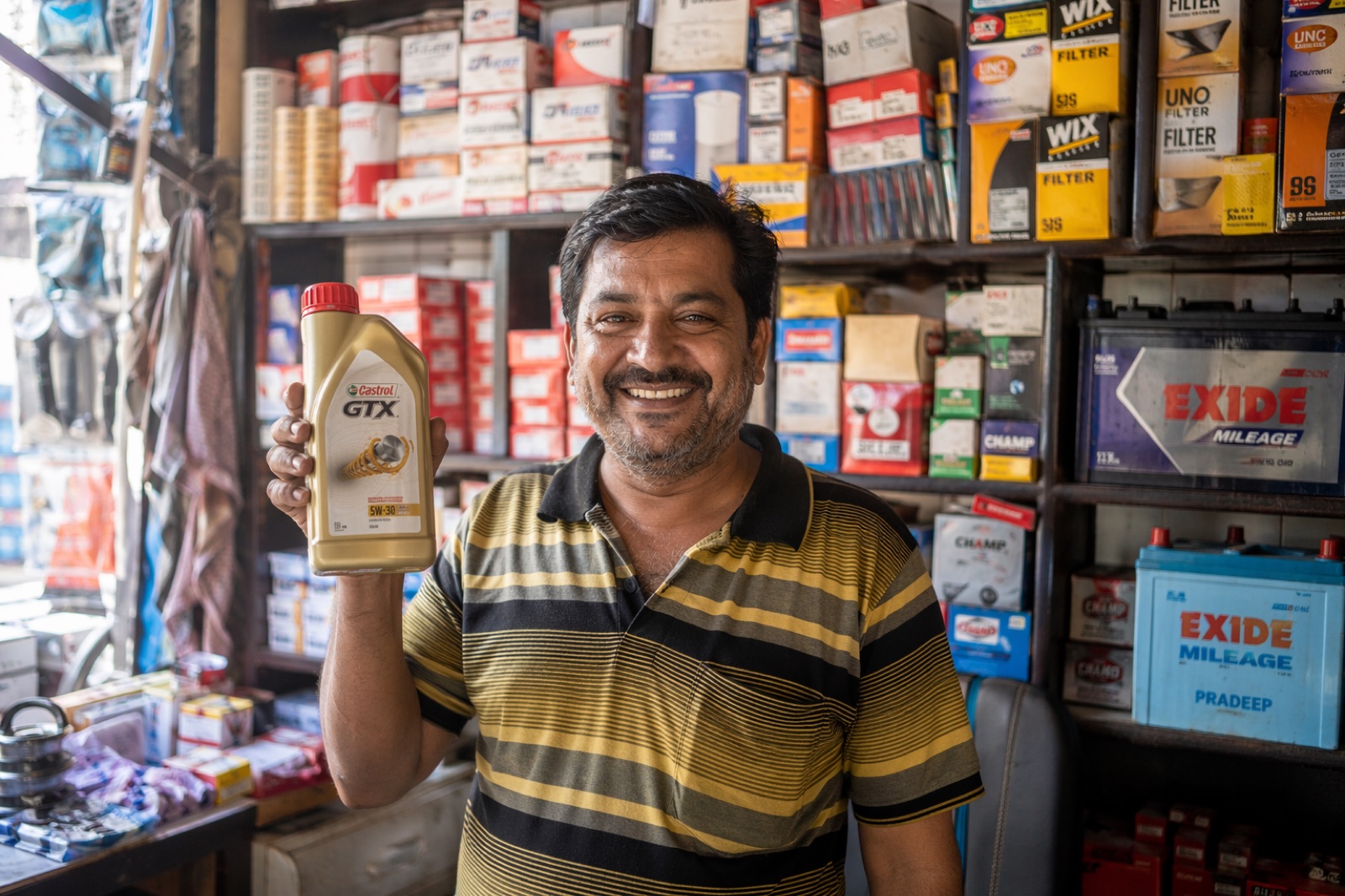
Automotive parts customer rebate management is the process by which an aftermarket brand calculates, validates and settles rebates for the three customer tiers in the parts channel: distributors, who earn on primary value, range and growth; counter retailers, who earn on sell-out proven by invoice upload or QR scan; and garages and mechanics, who earn per part fitted, proven by scanning a serialised code on the part or its box. The recurring challenges are returns and warranty claims that reverse a rebated sale, cross-territory selling by distributors, and duplicate proof across tiers, all of which are addressed by serialised QR proof, returns-adjusted settlement and a single ledger across the three tiers.
The aftermarket structure and who earns what
| Tier | Buys from | Rebate basis | Typical rebate type | Proof |
|---|---|---|---|---|
| Distributor | Brand | Primary invoice value | Volume slabs, range depth, growth on base, early payment | ERP invoices, net of returns |
| Counter retailer | Distributor | Sell-out to garages and walk-ins | Monthly quantity slabs on focus lines, range stocking | Distributor invoice upload or QR scan-in of stock |
| Garage or workshop | Retailer or distributor | Parts fitted | Per-part scan reward, monthly fitment slabs, tool and training tiers | Serialised QR scanned at fitment |
| Independent mechanic | Does not buy | Parts influenced or fitted | Per-scan reward, lucky draw, uniforms and tools | Serialised QR scanned at fitment |
The automotive industry page and the spare parts page describe the channel; this post is about the rebate mechanics on top of it. The garage and mechanic tiers are covered in depth in mechanic loyalty programs.
Rebate types that suit auto parts
Volume rebate
Slabs on quantity or value per period. Standard for distributors and counters. Pay marginally, and set the period to match the line's turnover: monthly for filters and brake pads, quarterly for clutches and bearings.
Range rebate
A fixed or percentage bonus for stocking a defined width of the catalogue, verified from invoice lines. The aftermarket has thousands of part numbers; range rebates are how a brand gets its slow movers onto the shelf.
Growth rebate
A percentage on purchases above the partner's own base, which lets a small counter in a tier-three town participate alongside a large distributor.
Warranty-return-adjusted rebate
Any rebate on a part that is later returned under warranty or as a commercial return should be reversed. Settle net of returns as of the settlement date, and claw back from the next period where a return follows settlement.
Fitment rebate
Per-part reward to the garage or mechanic who fits it, proven by scanning the serialised code. This is a rebate in economic effect and a loyalty reward in form; it belongs on the same ledger.
Proof of purchase and fitment through serialised QR
Parts and their boxes can carry a unique serialised QR per unit. The distributor's dispatch scan, the counter's stock-in scan and the mechanic's fitment scan then describe the path of one unit. A rebate at any tier can be validated against the unit's history: a counter cannot claim sell-out on units the distributor never dispatched to it, and a mechanic cannot claim a fitment on a unit already scanned in another city. The same code lets a car owner verify the part is genuine, which in a market with significant counterfeit filters and brake pads is often the reason the brand prints it. The serialisation guide covers the printing and keyspace side.
Fraud patterns specific to the aftermarket
- Returns after rebate. Parts billed to cross a slab and returned as unsold or under warranty after settlement. Defence: settle net of returns and claw back from the next period.
- Cross-territory selling. A distributor sells into another distributor's territory at a rebate-funded discount. Defence: geo-stamped scans at the counter and garage show where units actually land.
- Box-only scanning. Empty boxes scanned by a counter or a mechanic without a fitment. Defence: in-box codes, scan velocity limits, and a cap per garage per day.
- Duplicate proof across tiers. The same invoice used for a counter rebate and a distributor claim. Defence: one ledger with invoice and unit-level matching.
- Related garages. Several workshop names at one address. Defence: GSTIN, phone and location matching.
The fraud prevention guide has the detection rules; coupon fraud in trade schemes covers the code-leakage side.
Worked example: a filters and brakes brand
A brand selling oil filters at a distributor price of ₹180 and brake pad sets at ₹900 runs the following structure across 60 distributors, 2,400 counters and 9,000 garages. Figures are illustrative; the rebate calculator models your own.
| Tier | Rebate | Design | Illustrative monthly cost | Percent of tier revenue |
|---|---|---|---|---|
| Distributor | Volume plus range | 0.5, 0.75, 1 percent slabs on primary; ₹20,000 quarterly range bonus | ₹9 to ₹12 lakh on ₹12 crore primary | 0.75 to 1% |
| Counter retailer | Monthly quantity slabs on filters and pads | ₹4, ₹6, ₹8 per filter; ₹20, ₹30, ₹40 per pad set, marginal | ₹18 to ₹24 lakh | 1.5 to 2% |
| Garage | Fitment scan plus tool tier | ₹5 per filter, ₹25 per pad set; tool kit at 300 fitments | ₹12 to ₹18 lakh | 1 to 1.5% |
| All tiers | Total | One ledger, returns-adjusted, settled monthly | ₹39 to ₹54 lakh | 3.25 to 4.5% of primary |
Across comparable programs Unotag runs, the counter and garage tiers together produce a 10 to 20 percent lift in scan-verified sell-out on focus lines during the first two quarters, and returns-adjusted settlement removes 2 to 5 percent of claimed distributor rebate that would previously have been paid on stock that came back.
Managing the three tiers as one program
The mistake most aftermarket brands make is to run the distributor rebate in the ERP, the counter scheme through the regional sales team and the garage program through a marketing agency, so that nobody can see whether the ₹900 pad set the distributor was rebated on ever reached a garage. On one platform, the distributor's dispatch, the counter's stock-in scan and the mechanic's fitment scan are three events on one unit's record. The brand can then answer questions no single-tier program can: which distributors' stock actually reaches garages within 60 days, which counters sell to garages rather than to walk-ins, and which garages fit the brand consistently rather than only in scheme months. Those answers are what the next period's rebate structure should be built on, and they arrive as a report rather than as a field survey. The secondary sales tracking guide covers how the unit history is assembled.
Settlement and tax
Distributor rebates settle by credit note file into the ERP; counter and garage rebates settle by UPI at a ₹200 to ₹500 threshold or as points against a catalogue. Section 194R aggregation runs across all three tiers so that a garage earning cash, a tool kit and a lucky-draw prize in one year is handled correctly. GST treatment of credit notes and free goods follows the principles in the GST guide; confirm with your advisor.
Key takeaways
- Three customer tiers, three rebate bases: primary value for distributors, sell-out for counters, fitment for garages and mechanics.
- Serialised QR on the part or box gives one unit history that validates rebates at every tier and verifies genuineness for the car owner.
- Settle net of returns and warranty claims, and claw back from the next period; the aftermarket's return rates make this the largest single leakage.
- One ledger across tiers catches duplicate proof, cross-territory selling and related garages.
Frequently asked questions
What is automotive parts customer rebate management?
The process of calculating, validating and settling rebates for the customer tiers in the auto parts aftermarket: distributors on primary value and range, counter retailers on sell-out, and garages and mechanics on parts fitted, with proof from invoices and serialised QR scans.
How do aftermarket parts brands rebate garages and mechanics?
Per part fitted, proven by scanning a serialised QR on the part or its box at fitment, paid instantly by UPI or as points, with tool, uniform or training tiers at monthly fitment thresholds.
How are warranty returns handled in auto parts rebates?
Rebates should be settled net of commercial and warranty returns as of the settlement date, and any return after settlement clawed back from the partner's next period. Without this, returned stock earns a rebate.
What fraud is common in auto parts rebate programs?
Returns after rebate, cross-territory selling by distributors, empty-box scanning, the same invoice used across two tiers, and multiple garage names at one address. Serialised unit history, geo-stamped scans and one ledger across tiers address each.
What does an auto parts rebate program cost?
Across programs Unotag runs, distributor rebates land at 0.5 to 1 percent of primary, counter rebates at 1.5 to 2 percent of tier revenue and garage fitment rewards at 1 to 1.5 percent, for 3 to 4.5 percent of primary value in total.
Can one system manage rebates for distributors, counters and garages?
Yes. A channel platform runs all three tiers on one member base and ledger, with ERP invoices, invoice uploads and QR scans as proof, credit-note or UPI settlement and Section 194R aggregation across tiers.
Do auto parts rebates attract TDS?
Rebates and rewards in cash or kind to a resident in business can be benefits under Section 194R, with 10 percent TDS above ₹20,000 a year, aggregated across tiers and forms. Confirm the treatment with your advisor.